
Proprioceptors provide information of the position and movement of muscle and joints. In addition to exteroceptors (cutaneous receptors), proprioceptors mediate proprioception, the sense of position and movement of the body. Nevertheless, proprioceptors are crucial to reflexes. The three major groups of proprioceptors include: muscle spindles, golgi tendon organs and joint receptors.
Muscle spindles
Muscle spindles sense muscle length with typically 20-100 embedded in each muscle. They are a spindle shaped bundle of small specialised intrafusal muscle fibres (unlike the force-generating extrafusal muscle fibres).

The two types of muscle fibres include bag and chain fibres. Bag fibres have a swollen elastic central region and visco-elastic ends while chain fibres are visco-elastic throughout. Both fibres are innervated by large Ia afferents coiled around the middle in annulospiral rings and II afferents at the ends.
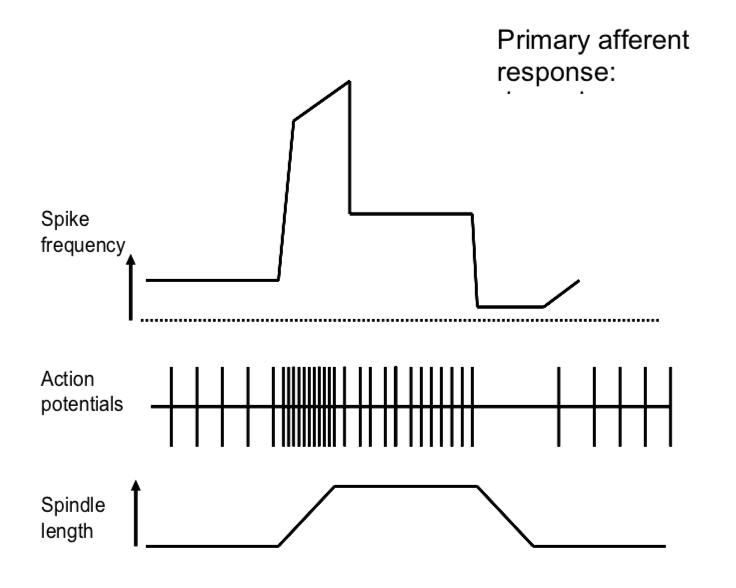

Bag fibres respond better to changes in stretch (i.e. rapidly adapting or dynamic response) as during rapid stretching, the elastic central region immediately elongate and create a strong initial activation of afferents. On the other hand, the viscoelastic chain fibres stretch more uniformly and signal muscle length linearly in static responses.
The picture however is complicated as the contractile ends of intrafusal fibres are innervated by slow conducting gamma motoneurons. Thus, muscle spindles can contract or relax to ensure they have the correct sensitivity (i.e. if slack due to muscle contraction, brain can increase drive to gamma motoneurons to contract the fibres and restore sensitivity). Efference copy (knowing the command given to the gamma motoneurons) is required to determine how much detected stretch is due to external factors (e.g. contraction of the muscle spindle is buried in) or internal factors (e.g. contraction of the spindle).
Golgi tendon organs
These only fire when the tendon is stretched. This occurs during active tension when the muscles contract, pulling on the tendon, as passive tension mainly involves stretching of the muscle instead of the tendon.
Joint receptors
Joint receptors signal joint position.
 MedMule
