
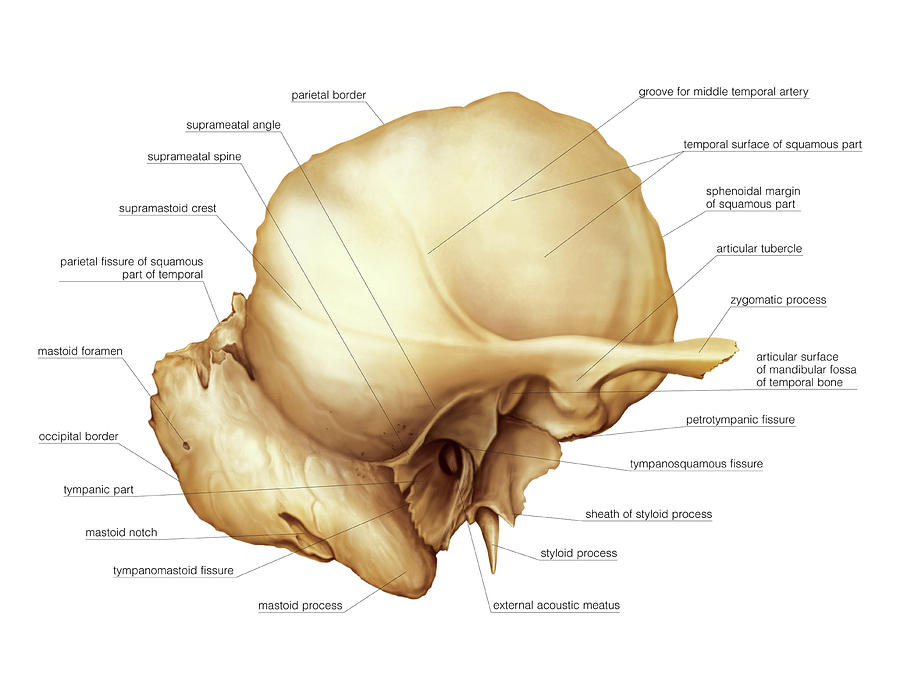
Each temporal bone is divided into squamous, petromastoid and tympanic parts as well as the styloid process. They mainly contribute to the lateral aspects of the middle cranial fossa and cup the temporal lobes of the brain.
- Squamous part: the flat superior portion, includes the zygomatic process (joins the zygomatic bones temporal process to form the zygomatic arch) and mandibular fossa (articulates with mandible via the temporomandibular joint)
- Petrous part: contains deeper structures including the middle and inner ear, internal auditory meatus, facial canal and jugular foramen
- Mastoid part: lies posteriorly, includes the mastoid process inferiorly (notably an attachment for the sternocleidomastoid and posterior belly of digastric) while filled with the mastoid air cells (that protect the inner/middle ear)
- Tympanic part: lies almost centrally, includes the external auditory meatus and attachment of the tympanic membrane
- Styloid process: extends inferiorly lateral to stylomastoid foramen where CN VII emerges, and is an attachment for ligaments and muscles
 MedMule