
Face
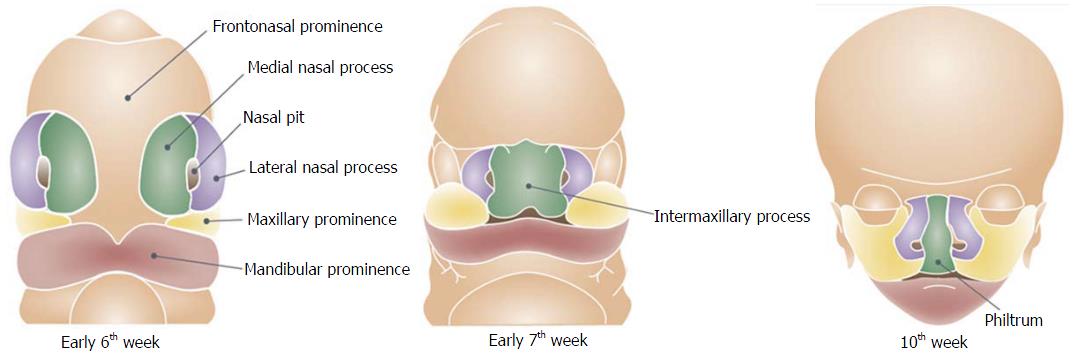
The external face forms between the 4th and 6th weeks of embryonic development. It initially involves degeneration of the oropharyngeal membrane that divides the primitive mouth and pharynx. The face is then completed by fusion of five neural crest-filled swellings of ectoderm:
- the unpaired medial frontonasal process which is divided into lateral and medial nasal processes on each side by the future nostrils. The medial nasal processes later fuse to become the intermaxillary process
- the bilateral maxillary and mandibular prominences (processes) derived from the 1st pharyngeal arch
CLINICAL CORNER
Facial clefts result from abnormal fusion of the 5 facial swellings, often a consequence of defects in neural crest development. Cleft lip can be unilateral or bilateral and occurs when the maxillary prominences don’t fuse with the medial nasal process and is treated by surgery.
Holoprosencephaly is a disorder caused by disturbed early forebrain development and can manifest in severe foetal alcohol syndrome (FAS). Symptoms include mental retardation as well as frontonasal process defects (such as agenesis of the intermaxillary process), clinically presenting as a single nostril (cebocephaly), close-set eyes (hypotelorism) or even a single eye (cyclopia).
Palate
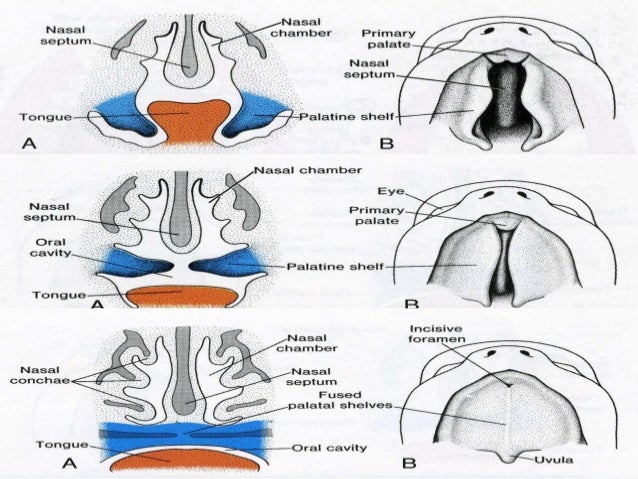
The anterior third and posterior two-thirds of the palate is formed respectively by the primary and secondary palates. From the 5th to 6th weeks, the primary palate is formed by fusion of the medial nasal and maxillary processes during facial development. Between the 6th and 12th weeks, the secondary palate forms from medial extensions of the maxillary prominences, the palatine shelves, which fuse with one another at the midline to divide the oral and nasal cavities. Growth of the palatine shelves depends on survival and proliferation of the neural crest-derived and mesoderm-derived cells of the first pharyngeal arch.
CLINICAL CORNER

Cleft palate results from incomplete fusion of the palatine shelves. Like with a cleft lip, it is usually treated with surgery.
 MedMule