

The laryngeal skeleton comprises of 5 main cartilages: the cricoid, thyroid, epiglottis and the paired arytenoids.
Epiglottis


The epiglottis is a leaf-shaped elastic cartilage deep to the body of the hyoid. It never calcifies, unlike the other cartilages that are made of hyaline cartilage which can even ossify in old age. The stem of the “leaf” points inferiorly while the tip rises approximately 1cm above the body of the hyoid at the back of the tongue. The mucous membrane is reflected from the anterior surface of the epiglottis to the back of the tongue in three longitudinal ridges known as the glossoepiglottic folds. The depressions on either side of the median fold on the superior surface of the epiglottis are termed valleculae. Inferior to each lateral glossoepiglottic fold are depressions known as the piriform fossae (sinuses).
Cricoid
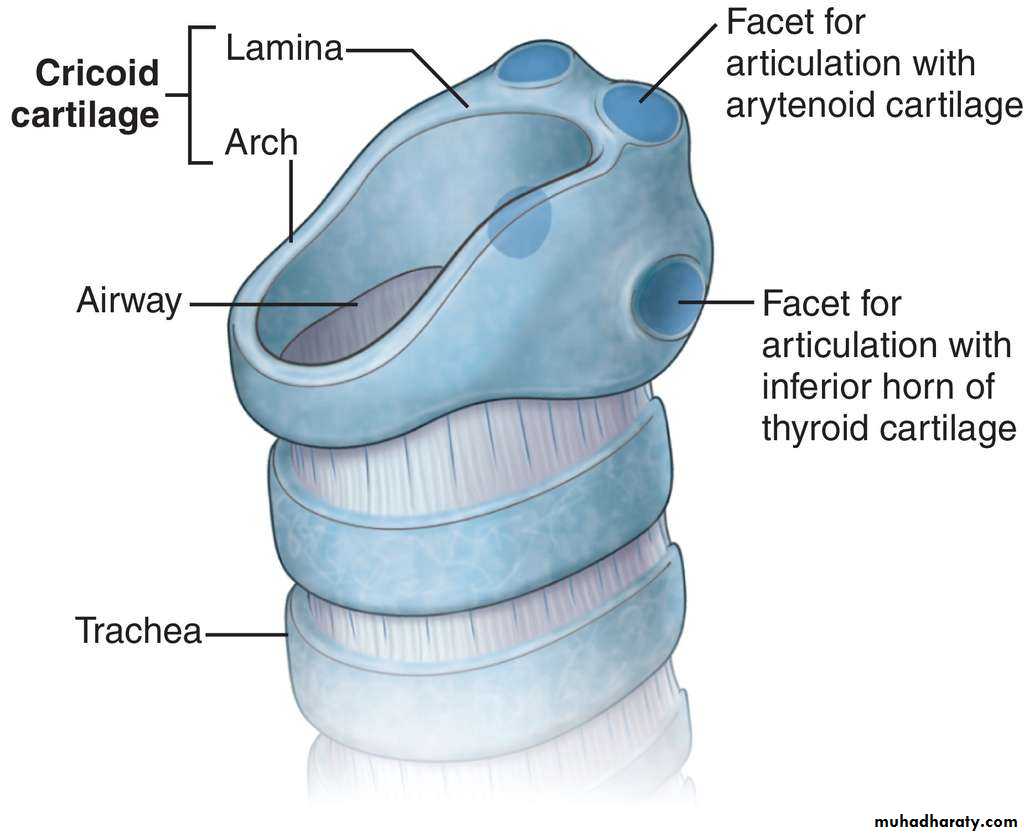
The cricoid is the shape of a signet ring in that the posterior part (lamina), is much taller than the remaining part (arch). The only complete cartilaginous ring in the respiratory tract, it is the foundation of the laryngeal skeleton. On the external surface of the arch are facets for articulation with the inferior horns of the thyroid cartilage. Facets on the superior rim of the cricoid cartilage are for articulation with the arytenoid cartilages.
Thyroid cartilage
The thyroid cartilage lies below the hyoid bone and consists of two flat pentagonal plates known as the laminae, whose anterior junction constitutes the laryngeal prominence. Although there is little difference in children, the angle of the adult laryngeal prominence is 90º in males and 120º in females due to enlargement of the cartilages in males after puberty. The vocal cord length nearly doubles, though pitch change in males is primarily related to the mass and structure of the vocal folds. The posterior borders of the laminae project upwards and downwards as the superior and inferior horns (cornua). The superior border is connected to the hyoid via the thyrohyoid membrane.
Arytenoid cartilage
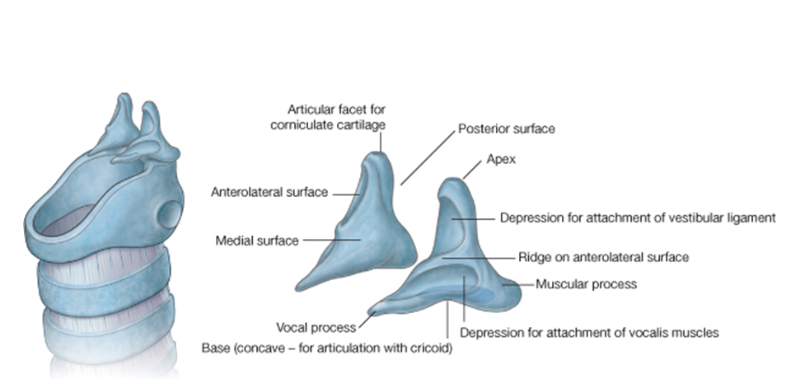
Each arytenoid cartilage resembles a three-sided pyramid. The anterior-most point on the base is elongated to form the vocal process, to which the vocal ligament attaches. The muscular process is a lateral projection from which attach the posterior and lateral cricoarytenoid muscles. The base of each cartilage articulates with the sloping shoulder on the upper border of the cricoid lamina via a synovial joint that allows rotatory and gliding movements.
 MedMule
