

Extrinsic laryngeal muscles move the position of the larynx and are divided into the elevators and depressors. This may be useful for closing the laryngeal inlet when swallowing and for phonation
Elevators of the larynx

These muscles move the larynx upwards to close the laryngeal inlet during swallowing. Since they larynx is connected to they hyoid, elevator muscles can act:
- via the hyoid: the suprahyoid muscles (mylohyoid, stylohyoid, geniohyoid, digastric) pull the hyoid bone upwards
- directly on larynx: stylopharyngeus, palatopharyngeus, salpingopharyngeus
Depressors of the larynx
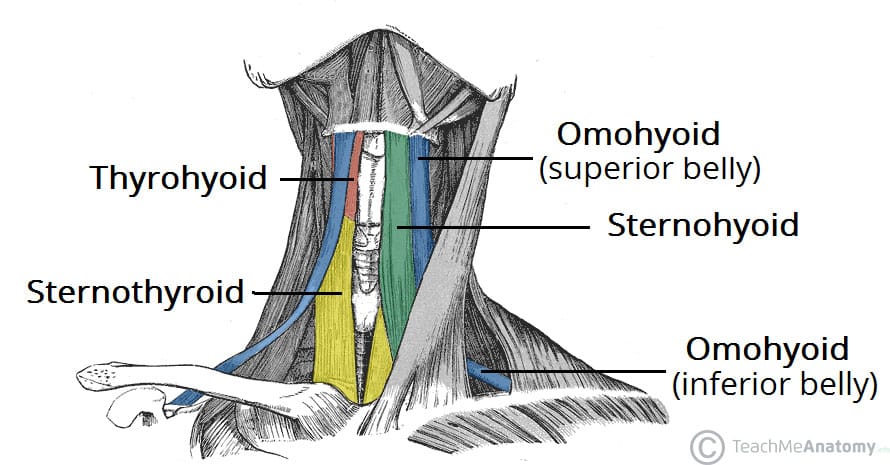
Although the elevated larynx returns to rest position by elastic recoil of the trachea, active depression occurs during deep inspiration and can increase the capacity of the resonating chambers during low frequency phonation. They act:
- via the hyoid: the infrahyoid muscles (sternohyoid, omohyoid, thyrohyoid) pull the hyoid bone downwards
- directly on larynx: sternothyroid
 MedMule