
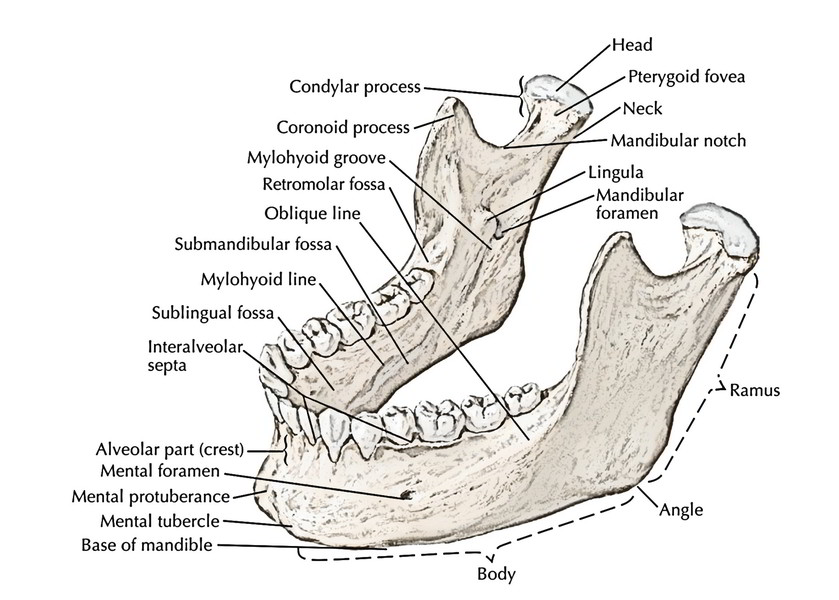
Instead of being connected by sutures, the mandible is the only movable skull bone, articulating via the temporomandibular joints (TMJ) with the temporal bone. It may be depressed, elevated, protruded, retracted and even move side to side during grinding movements. On each side, a ramus joins the a horseshoe-shaped body an inclination, forming the mandibular angle. Notable landmarks of each ramus include the head (articulates with the TMJ), neck (attachment of the lateral pterygoid muscles) and coronoid process (insertion of temporalis). Meanwhile, the body is divided into the alveolar border superiorly which contain sockets for the teeth and the basal surface inferiorly.

The inferior alveolar nerves (branch of CN Vc) enters the mandible through the mandibular foramen medially on the rami to supply sensory sensation to the lower teeth and exits through the mental foramen anteriorly from the body as the mental nerve providing sensory innervation to the chin.
CLINICAL CORNER
The mandible is the second (after the nasal bones) most commonly fractured facial bone. Since the force of trauma may be transmitted along the mandible, fractures can be removed from the point of impact with multiple more frequent than single fractures. Associated severe cervical spine injuries may also be sustained.
 MedMule