

Three pairs of salivary glands produce saliva that moistens and begins chemical breakdown of food. They are the sublingual, submandibular and parotid glands. Parasympathetic secretomotor supply to the former two glands comes from the facial nerve via its chorda tympani branch and the submandibular ganglion whilst the parotid gland is innervated by the glossopharyngeal nerve.
Sublingual glands
Each sublingual gland (beneath the tongue) lie on the superior surface of mylohyoid and along the inner surface of the mandible. They open into the sublingual region via several small, short ducts.
Submandibular gland
Each bilobed submandibular gland lies in the submandibular fossa under cover of the body of the mandible. Its superficial lobe is separated from the parotid gland by the stylomandibular ligament, and is grooved by the facial artery. The deep lobe passes with its duct around the free posterior border of the mylohyoid. The duct extends upwards and forwards to open on the papilla beside the lingual frenulum.
CLINICAL CORNER
The submandibular gland secretes more viscous saliva due to higher concentrations of mucus compared to the other glands. This slows salivary flow and may contribute to salivary gland calculi and stasis in certain pathologies. If blocked by a calculus, the gland swells up and becomes painful as saliva is produced. Transoral extraction of such a calculus blocking the orifice of the duct may be performed under local anaesthesia.
Parotid gland
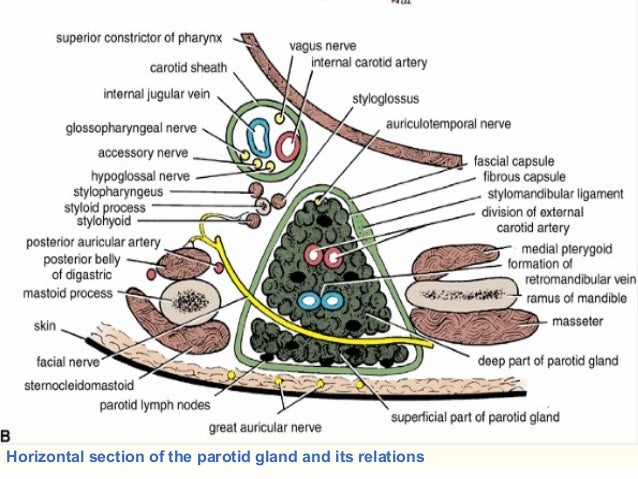
Largest of the salivary glands, each parotid gland lies mainly behind the mandible. It also extends onto the lateral surface of the mandibular ramus and masseter. Its duct crosses masseter and pierces buccinator to enter the mouth opposite the upper second molar tooth. Parasympathetic secretomotor supply comes from the glossopharyngeal nerve (CN IX). Its tympanic branch gives the lesser petrosal nerve, which synapses in the otic ganglion. Postganglionic branches join the auriculotemporal nerve to supply the gland.
CLINICAL CORNER
The mumps virus commonly infects the parotid glands and if so may spread to the other salivary glands, brain, pancreas, and testes (the latter may result in sterility). Effective immunity is provided by the combined MMR vaccine.
Parotid gland tumours may be benign or malignant. The most common benign tumour is a pleomorphic adenoma which is often asymptomatic, only noted incidentally while washing or shaving. Malignant parotid tumours are usually highly invasive and may involve the facial nerve, causing unilateral paralysis.
 MedMule