
Malaria is a disease caused by protists, specifically, Plasmodium vivax, knowlesi, ovale, falciparum, or malaria. These pathogens are spread by female Anopheles mosquitos (which feed on blood), although males are important in giving off the hormone 20-Hydroxyecdysone, that helps the plasmodium grow. P. ovale and knowlesi are sympatric species.
Risk factors
- pregnancy
- age
- immunosuppressed
- NOT sickle cell anaemia
Life cycle
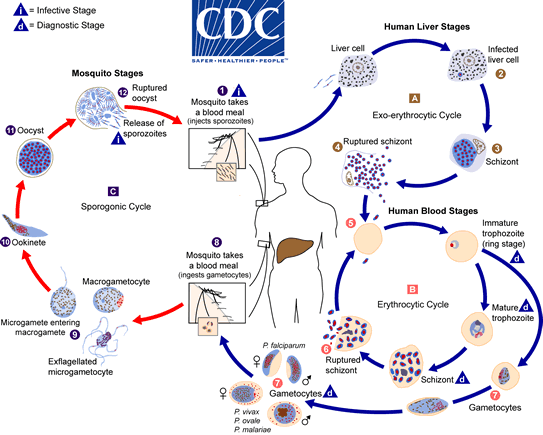
In mosquitoes, Plasmodium exists as sporozoites, which are injected into the human when the mosquitoes. Motile, the sporozoites travel through lymph to the liver and infect hepatocytes. In hepatocytes in which they undergo mitosis (in a process called schizogony) to become merozoites.
Bursting out, they then infect red blood cells: they first have a low-affinity interaction with the membrane, then injects proteins into the RBC cytoplasm which binds to ligands on the merozoite surface in a process before they are endocytosed similar to the process of zipper formation. In the RBC, they get nutrients from proteolysis and become schizoids, which multiply and lyse the RBC, before invading other RBC in a cycle.
Nevertheless, some schizoids differentiate into male and female gametes (regulated by AP2G). These enter the gut of the female Anopheles mosquito when it feeds, gradually turning into macrogametes. These macrogametes undergo mitosis into 8 microgametes which find macrogametes to couple with form a zygote. The zygote matures into sporozoites, completing the life cycle. Only in P. vivax and P. ovale, is there a hypnozoite stage, where the Plasmodium are dormant in the liver, allowing them to survive at lower temperature climates.
Based on their erythrocytic life cycle, malaria can be classed as: tertian (3 day cycle, fever every 2 days), quartan (4 day cycle, fever every 3 days) and quotidian (daily cycle). Plasmodium malaria the mildest.
Symptoms
Symptoms can be divided into: asymptomatic, uncomplicated, and severe (organ damage). Malaria (e.g. falciparum) can be sequestered in the immune privileged brain, blocking cerebral vessels and leading to stroke.
Pathogen-host interaction
Plasmodium induces a Th1 immune response (as the pathogen is intracellular). The Duffy antigen (found on blood) receptor allows entry by some species of malaria (P. vivax). Since most Africans don’t have this antigen, P. vivax is uncommon in Africa.
Individuals also have a strong hepcidin response to malaria, causing reabsorption of iron in macrophages which Plasmodium needs for proliferation (which is why they infect liver first). While this generally means individuals cannot support two strains of malaria at the same time, this is not perfect as P. vivax and P. falciparum coinfections occur.
In first-time pregnant women, VAR2 (Variant surface antigen 2) bind to CSA 2 in the placenta. They block vessels in the placenta.
Treatment
Drugs: Artemisinin, dihydrofolate reductase inhibitors (e.g. proguanil) that inhibit the pentose phosphate pathway
 MedMule