
The outer ear includes the auricle/pinna and the external auditory meatus. It funnels sound waves in the air onto the tympanic membrane, which not only vibrates in response but also divides the outer and middle ear. Blood supply mainly comes from the posterior auricular artery (a branch of the external carotid artery).
Auricle
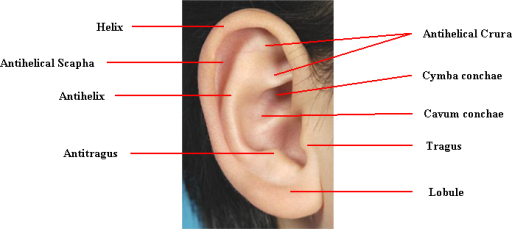
The auricle is the visible part of the ear outside the head and consists of ridged elastic cartilage covered with skin. Anterior to the meatal opening is the tragus, with the concha posteriorly. The helix makes the outer edge while the lobule projecting inferiorly is made of fibrofatty tissue.
Innervation of the auricle
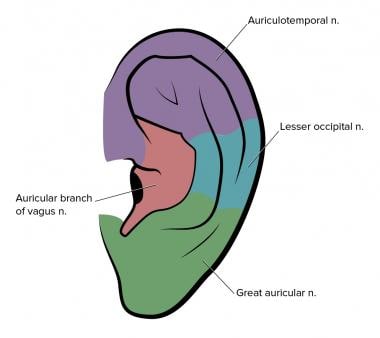
The auricle is innervated by:
- auriculotemporal nerve (from CN V3)
- the auricular branch of the vagus nerve (CN X)
- lesser occipital and great auricular nerves, respectively C2 and C2-3 branches of the cervical plexus.
External auditory meatus

The external auditory meatus (ear canal) is an approximately 3 cm canal extending medially (in a sigmoid path slightly anteriorly) from the concha of the auricle to the tympanic membrane. It is lined by hairy skin and ceruminous glands which secrete wax. The lateral third is mostly cartilaginous and continuous with the auricle with a fibrous posterosuperior portion. Meanwhile, the bony medial two-thirds has a groove around the sides and floor for the attachment of the tympanic membrane.
 MedMule