
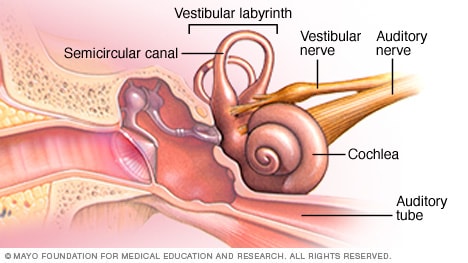
The inner ear is supplied by the vestibulocochlear nerve (CN VIII) and contains the sense organs for hearing and balance. It consists of the osseous labyrinth (consisting of the vestibule, semicircular canals, and cochlea), which contains the membranous labyrinth. For balance, the utricle and saccule located in the vestibule and are responsible for static equilibrium, while the semicircular ducts in the canals are concerned with dynamic equilibrium. Meanwhile, the cochlea is the organ mediating hearing.
CLINICAL CORNER
Vestibular disorders give rise to dizziness and nausea. To test balance, postural stability is observed with patient eyes closed (to prevent visual compensation). Important reflexes involving the vestibular nerve can also be tested in conscious/unconscious patients. Vestibulo-ocular (dolls-eye) reflexes should keep the gaze fixed when the head is passively moved (dolling, where eyes move equal and opposite to the head). The vestibular system is further activated by thermal (caloric) stimulation, tested by irrigating the ear canal with warm or icy water. Thermal convection currents set up in the inner ear fluid can activate the vestibular system and generate nystagmus (continuous flicking movements of the eyes).
An acoustic neuroma is a benign intracranial tumour of the myelin-forming cells of the vestibulocochlear nerve, often resulting in deafness and disturbances of balance and gait. It may be treated with a translabyrinthine approach surgery which not only destroys hearing in the affected ear but could also endanger the facial nerve.
 MedMule