
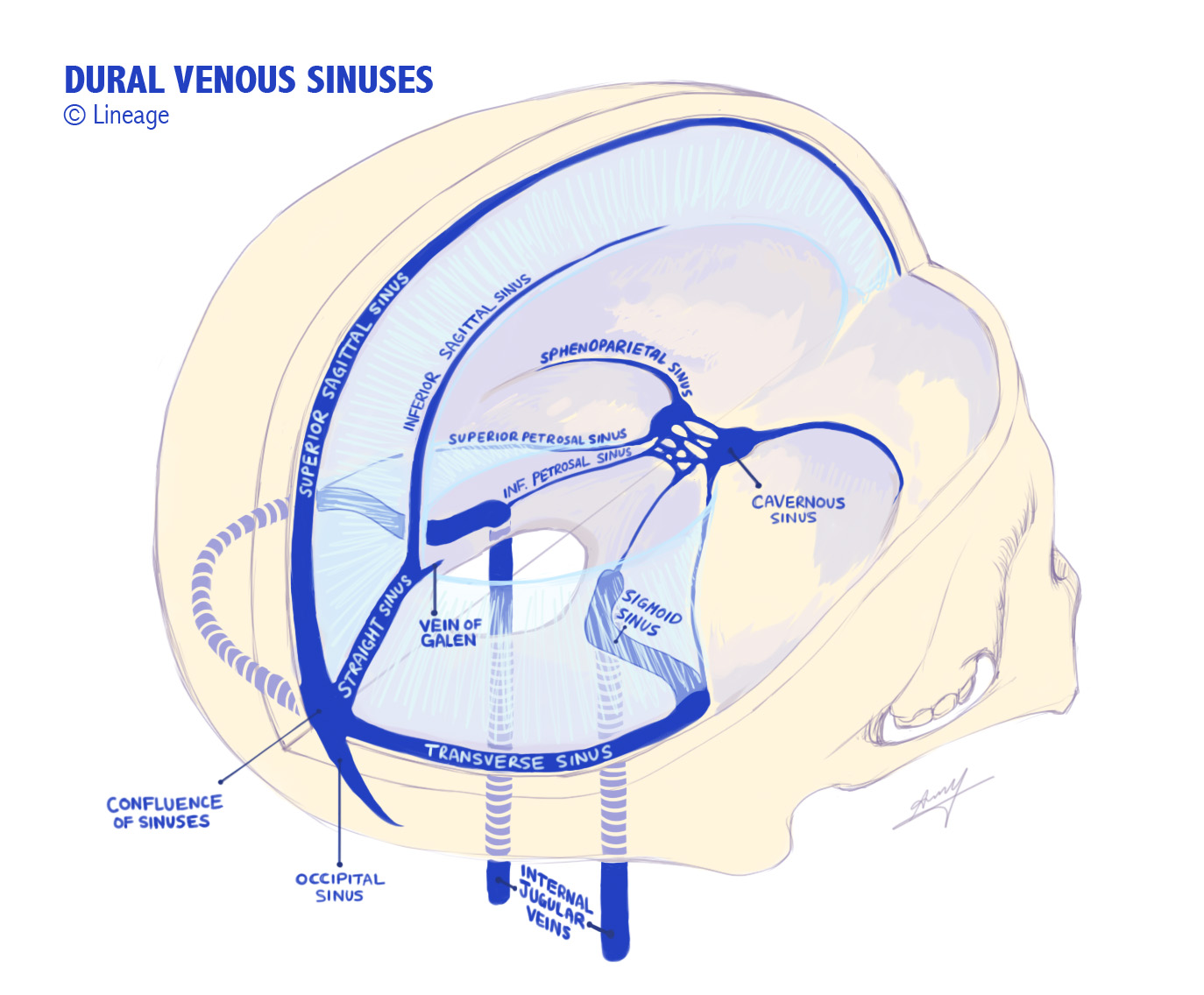
At certain sites, the two layers of dura mater separate to form the dural venous sinuses – the system for venous drainage of the cranium and brain. These are lined by vascular endothelium, with no valves or muscular tissue, and ultimately drain into the internal jugular veins.
Sagittal sinuses
The superior sagittal sinus runs in the superior margin of the falx cerebri from the crista galli, usually draining to the right transverse sinus, in doing so grooving a the cranial vault medially. The inferior sagittal sinus runs in the posteroinferior border of the falx cerebri and joins the great cerebral vein as well as the right and left basal veins to form the straight sinus.
Straight & transverse sinuses
The straight sinus runs in the junction of the falx cerebri and tentorium cerebelli, generally continuing as the left transverse sinus. The transverse sinuses run on each side in the lateral margin of the tentorium cerebelli and receive the superior petrosal sinus to become the sigmoid sinus.
Sigmoid sinuses
:background_color(FFFFFF):format(jpeg)/images/library/2805/igrU0nL18cFHkPVVvyXDag_Sulcus_sinus_sigmoidei_02.png)
Each S-shaped sigmoid sinus grooves the petrous temporal bone and curves forward onto the occipital bone to enter the jugular foramen. There, it joins the inferior petrosal sinus to form the internal jugular vein. The mastoid air cells lie lateral to it.
Cavernous sinuses

The cavernous sinuses lie on either side of the sphenoid bone body. Numerous delicate, interlacing connective tissue strands within create a cavern-like mesh. It receives the superior and inferior ophthalmic veins, thus connecting with the extracranial facial vein and the pterygoid (venous) plexus. The internal carotid artery runs centrally through the sinus beside the abducens nerve (CN VI) while the oculomotor, trochlear, ophthalmic and maxillary nerves (CN III, IV, Va & Vb) run next to the lateral wall.
CLINICAL CORNER
Cavernous sinus thrombosis is a very lethal condition where clot formation can restrict blood flow in the brain. Often precipitated by infection (such as from the danger triangle of the face), symptoms can include vision and eye movement problems (due to the nerves passing through the sinus).
Petrosal sinuses
The petrosal sinuses drain the cavernous sinuses. Each superior petrosal sinus runs in the tentorium cerebelli edge that attaches to the petrous temporal bone and joins the transverse sinus to become the sigmoid sinus. Each inferior petrosal sinus lies in the groove between the occipital and petrous temporal bones to drain into the internal jugular vein.
 MedMule